
Of That Irreducible Terrain (Part II)
Nature Is Human Is Nature
Humanity and humility share a common linguistic heritage meaning earth or of the ground. Early conservation seems decidedly not grounded nor humble. It did not arise from a rootedness in place but from the imposition of elite ideals detached from ecological context and truths. John Burroughs’ (1837-1921) prolific writing was part of the zeitgeist of Gilded Age conservation and Nature enthusiasts. In his 1895 book, Accepting the Universe, he observed,
“Man has taken himself out of the category of natural things, both in his origin and in his destiny. Such a gulf separates him from all other creatures, and his mastery over them is so complete that he looks upon himself as exceptional, and as belonging to another order. … In our floods of religious emotion we instinctively look away from the earth.”
Henry David Thoreau’s writing was also foundational to early conservationists. He too could see the inherent disconnect and blind spots in early conservationists’ notion of Nature. In his essay, Walking, from 1862, he wrote, “There is plenty of genial love of Nature, but not for Nature herself. Her chronicles inform us of when her wild animals, but not the wild man in her, became extinct.”
Founding impulses of mastery, exceptionalism, and looking away from the earth and the people most intimately connected with it, have often characterized—if not distorted—the work and impact of land conservation as it has unfolded over a century and a half. Land is intimately entwined with the most haunting and violent transgressions of our collective history, and though they may be places of serenity today, the residues of tears and blood remain in the soil of saved lands across the U.S. As reminded by Roxanne Dunbar-Ortiz in, An Indigenous Peoples’ History of the United States, “Everything in U.S. history is about the land—who oversaw it and cultivated it, fished its waters, maintained its wildlife; who invaded and stole it; how it became a commodity broken into pieces to be bought and sold on the market.” Today’s conservation and land efforts hold the implications of this legacy, consciously or not. The promise of a greater earthliness and grounding of land conservation through co-evolving with social justice and Indigenous movement seems a gift.
The growth and evolution of the conservation movement through land trusts is remarkable and reflects the tangible impact of protecting and holding land for the benefit of wildlife and other values of the heart and soul but for which no price tag exists. Now in their third century, land trusts have grown from a handful of entities at the turn of the 20th century to over a thousand active nonprofit organizations, operating from the community to the national scales across the entire U.S. and beyond, protecting over sixty-one million acres of land. With time, however, we gain perspective on that original conservation and land trust impulse. The work and writings of historians and scholars today, such as Dorceta Taylor and William Cronon, show that notions of Nature and all the people held by Gilded Age elites were perhaps misnomers, or at least historically conditioned and culturally limited conceptions. Nature from this worldview was void of people and human influence, often blind or dehumanizing to the people responsible for shaping a landscape that was wantonly perceived as virgin.
We now know from pre-Columbian studies through a variety of disciplines that the ‘New World’ was much closer to what Cronon described as “a landscape whose essential characteristics were kept in balance by the cultural practices of its human communities.” Such a landscape was maintained for thousands of years prior to European colonization, and glimpses of it can even be found in our own written records. An 1825 report on the territory of the Cherokee Nation from the Superintendent of Indian Affairs, Thomas L. McKenney, reads:
“The country is well watered; abundant springs of pure water are found in every part; a range of majestic and lofty mountains stretch themselves across it. The northern part is hilly and mountainous; in the southern and western parts there are extensive and fertile plains, converted partly with tall trees, through which beautiful streams of water glide. These plains furnish immense pasturage, and numberless herds of cattle are dispersed over them … The climate is delicious and healthy; … flowers of exquisite beauty and variegated hues meet and fascinate the eye in every direction. In the plains and valleys the soil is generally rich, producing Indian corn, cotton, tobacco, wheat, oats, indigo, and sweet potatoes.”[i]
In their book, The Dawn of Everything—a fresh and sweeping look at the most recent evidence in archeology, anthropology, and historical ecology—David Graeber and David Wengrow show that historic evidence from across these disciplines suggests that ancient Indigenous’ cultures foraging and agroecological practices influenced ecosystems across the globe. They write,
“fluid ecological arrangements—combining garden cultivation, flood-retreat farming on the margins of lakes or springs, small-scale landscape management (e.g. by burning, pruning, or terracing) and the corralling or keeping of animals in a semi-wild state, combined with a spectrum of hunting, fishing, and collecting activities—were once typical of human societies in many parts of the world.”
Results from new and emerging works continue to clarify and detail this larger socio-ecological picture that has been veiled if not misinterpreted. A recent paleoecological investigation published in the Proceedings of the National Academy of Sciences found that current global patterns of vertebrate species richness are more strongly associated with past patterns of human land-use than with present absence of use in areas characterized as wild.[ii] In 2022, a team of biologists that conducted a rapid biological assessment of the Alto Mayo region of Peru found twenty-seven species new to science and forty-nine species that are threatened with extinction globally. These are truly astonishing scientific results, even for the most remote and uncharted regions of the globe. What makes these results even more stunning is that the study area was within a more densely populated central region of Alto Mayo that include “bustling cities, towns and farmlands.” Despite this development pressure, researchers were shocked at the “sheer variety of life” they found.[iii]
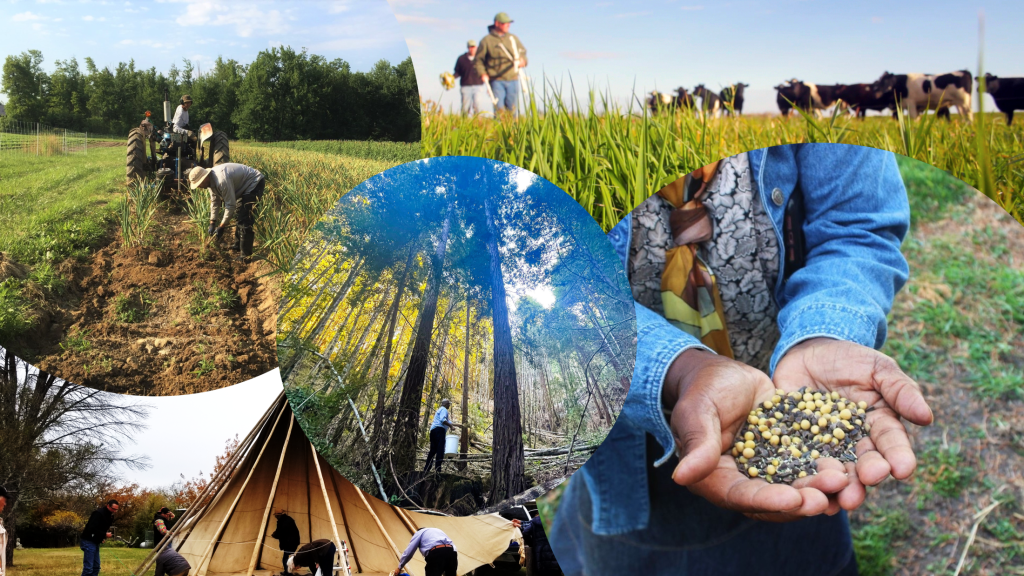
It seems it is not the absence of humans but the presence of humans living lightly on the land, attuned to other forms of life, and working in harmony with natural cycles that is quintessential Nature.
Land, and our relationship with it, is much more than a historical footnote. Ecologically healthy landscapes are key to a livable future in this era of climate change. There is no path forward to a resilient and sustainable future that does not include working with nature to restore the capacities and cycles of terrestrial and hydrologic systems to help mitigate atmospheric carbon and adapt to a much more volatile world. A team of more than two hundred scholars, scientists, policymakers, business leaders, and activists convened by Project Drawdown to vet and disseminate a list of the most viable solutions to climate change, identified over thirty focus areas associated with land, water, and agriculture. Such solutions included forest protection, wetlands restoration, Indigenous Peoples’ land stewardship, regenerative agriculture, silvopasture, afforestation, managed grazing, and perennial biomass, to name but a few. Land remains the source of our food, the cradle of our communities, and the foundation of our economies. Land is, as Eric Holt-Giménez and Justine Williams so poignantly state in their essay Together Toward Land Justice, “that irreducible terrain of hope from which all other struggles for food, livelihoods, water, and environment emerge.”
[i] In, A Century of Dishonor, by Helen Jackson, 1885.
[ii] People have shaped most of terrestrial nature for at least 12,000 years, Ellis et. al., 2021, Proceedings of the National Academy of Sciences, volume 118 number 17.
[iii] A Rapid Biological Assessment of the Alto Mayo Landscape, San Martin, Perú, RAP Bulletin of Biological Assessment #73, Conservation International, 2024.